
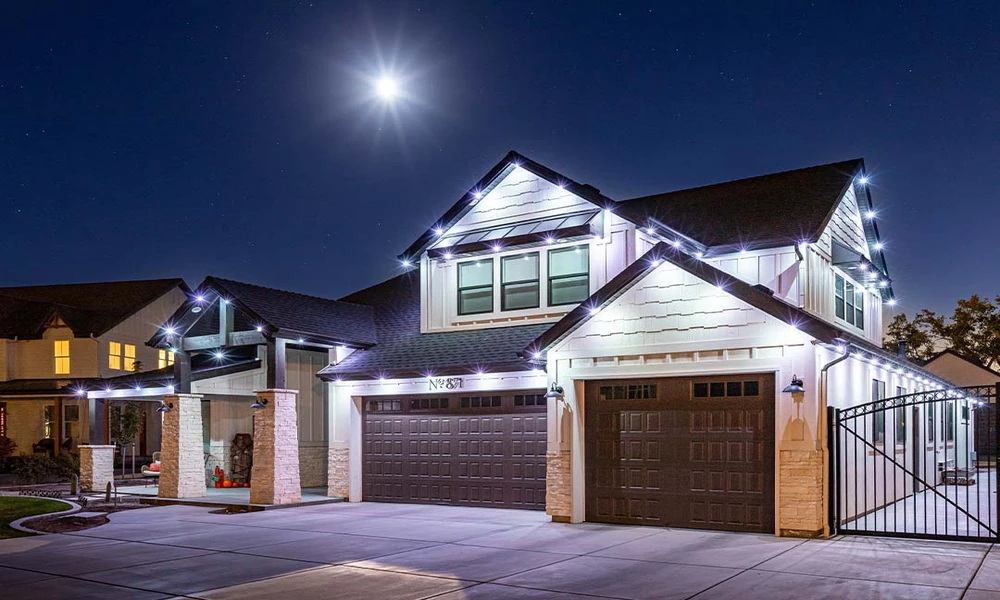
Outdoor lighting can make a big difference in how a home looks, feels, and functions after dark. A well-lit driveway makes it easier to pull in after work, illuminated walkways help family members and guests get to the front door safely, and strategically placed security lights can make it easier to keep an eye on areas around the property. With today’s smart technology, homeowners can take these benefits a step further by automating when exterior lights turn on, adjusting brightness remotely, and connecting lighting with compatible security devices.
For homeowners in Dripping Springs, Texas, outdoor lighting deserves special consideration. Many properties have long driveways, private entry gates, detached garages, workshops, barns, and expansive yards that extend well beyond the main house. Lighting these spaces effectively takes more than installing a few fixtures along the porch. It requires thoughtful planning, dependable electrical connections, and controls that suit the property’s layout.
Smart outdoor lighting installation offers a practical way to manage these areas without constantly walking outside to flip switches or leaving lights on throughout the night. Whether you’re improving an established home in Dripping Springs or building out an acreage property, the right setup can make everyday life more convenient while improving visibility around important areas.
Why Smart Outdoor Lighting Makes Sense for Dripping Springs Homes
In a neighborhood with a short driveway, one porch light and a garage light might provide enough illumination. On a larger Hill Country property, however, the situation can be very different. A driveway may wind past trees before reaching the house, a detached workshop may sit several hundred feet from the main building, or an entry gate may be too far away to benefit from the lighting installed near the garage.
Smart lighting gives homeowners more control over these separate areas. Depending on the equipment selected, lights can operate according to schedules, respond to motion, follow sunrise and sunset times, or be controlled through a smartphone.
Instead of treating every outdoor fixture as an independent light, homeowners can organize their exterior lighting into useful groups. Driveway lights might operate differently from porch lights, while security lighting around a workshop could activate only when motion is detected.
The goal is to create a system that works naturally with the way you use your property. Tejas Electric can help homeowners consider their lighting needs, existing electrical infrastructure, and options for professional smart home installation.
1. Automating Long Driveways, Entry Gates, and Detached Garages
Long driveways are common on acreage properties throughout the Dripping Springs area. Without adequate lighting, navigating a dark entrance can be uncomfortable, especially when returning home late at night, backing out of a garage, or meeting visitors after sunset.
Smart outdoor lighting can help address these challenges by providing illumination where it is needed most.
Lighting long driveways and private entrances
Driveway lighting can include low-profile path lights, directional landscape fixtures, pole-mounted lights, and appropriately positioned floodlights. Each option serves a different purpose.
Low-level fixtures can help define the edges of a driveway without producing excessive glare. Brighter fixtures may be appropriate near sharp turns, parking areas, or gates where drivers need better visibility. On properties with winding access roads, lighting can also help distinguish the driveway from surrounding landscaping.
Smart controls make these installations more convenient. Depending on the system, lights can turn on at sunset, activate when a vehicle approaches, or operate on a predetermined schedule.
Homeowners should consider how much illumination is actually necessary. Excessive brightness can create glare for drivers and shine into neighboring properties. A well-planned installation focuses light on the ground and the areas where visibility matters.
Connecting smart lighting to entry gates
An automated entry gate introduces additional considerations. Homeowners may want lighting that activates when the gate opens, illuminates the keypad, or provides visibility for visitors entering the property.
Some systems can coordinate these functions through compatible controllers, relays, or smart-home platforms. Compatibility needs to be confirmed before assuming that a gate opener, lighting controller, and security system will communicate with one another.
The electrical installation should also account for the distance between the gate and the house. Depending on the design, the project may require a properly sized underground electrical circuit, suitable conduit, or another approved power solution. Low-voltage lighting may be appropriate in some situations, but its transformer, wiring, and controls still need to be selected for the intended installation.
Long distances can introduce voltage-drop concerns, so the wiring design should account for the connected load and cable length.
Lighting detached garages, workshops, and outbuildings
A detached garage or workshop often needs a different lighting strategy from the main house. Homeowners may use these spaces early in the morning, after dark, or for projects that extend into the evening.
Exterior lights can illuminate garage doors, side entrances, equipment storage areas, and paths between buildings. Smart controls can also allow different lighting zones to operate independently.
For example, a homeowner might schedule the driveway lights to switch off late at night while keeping a motion-activated light near the workshop entrance. This provides useful illumination without keeping every fixture running continuously.
When planning these installations, consider the distance between buildings, existing electrical capacity, underground utilities, and whether a detached structure already has a suitable electrical supply.
2. Using Motion-Activated Lighting Around Entrances and Outbuildings
Motion-activated lighting is one of the most useful features of a smart outdoor lighting system. It provides illumination when someone approaches a designated area rather than requiring lights to remain on all night.
This can be especially helpful around side doors, garage entrances, equipment sheds, barns, and less frequently used portions of an acreage property.
Where motion sensors work best
Common locations include:
- Front and rear entrances where visitors approach after dark.
- Side gates and access paths that receive little regular foot traffic.
- Detached garages and workshops where homeowners park or retrieve equipment.
- Storage sheds and outbuildings containing tools or outdoor equipment.
- Walkways connecting the house with patios, parking areas, or guest spaces.
Sensor placement matters. A sensor aimed toward a busy road may activate every time a passing vehicle moves through its detection zone. One installed too close to a fixture may also behave unpredictably, depending on the equipment and environmental conditions.
Trees, changing sunlight, temperature differences, and the movement of pets can influence some motion sensors. Adjustable sensitivity, detection range, and timeout settings can help reduce unnecessary activation.
Combining motion sensors with smart controls
A smart motion-activated system may allow homeowners to change settings remotely or establish different lighting behaviors for different times of day.
For example, a workshop light could operate at a low brightness level during the evening and switch to full brightness when motion is detected. A side entrance light could turn on automatically when someone approaches, then switch off after several minutes without further activity.
These features depend on the specific fixture, sensor, and controller. Some smart floodlights have built-in motion detection, while others require separate compatible sensors or a smart-home hub.
Homeowners should also distinguish between improved visibility and actual security. Lighting can make it easier to see activity around a property, but it does not guarantee that trespassing or theft will be prevented.
3. Automating Porch and Landscape Lighting at Sunset and Sunrise
Porch lighting is often one of the first outdoor lighting upgrades homeowners consider. It makes the entrance easier to find, creates a welcoming appearance, and provides illumination when family members arrive home after dark.
The challenge is remembering to turn the lights on and off consistently. Smart controls can handle that task automatically.
Use schedules that follow changing daylight
A fixed timer can work well, but sunrise and sunset times change throughout the year. A smart lighting controller with astronomical scheduling can adjust its operating times as daylight changes.
For example, front porch lights might turn on shortly before sunset and switch off at sunrise. Landscape lighting could follow a separate schedule, operating only during the hours when homeowners are most likely to enjoy the outdoor spaces.
This is useful for homes with landscaped entrances, patios, outdoor kitchens, covered porches, and decorative trees.
Some systems allow schedules to change automatically based on local sunrise and sunset times. Others offer adjustments such as switching on 15 minutes before sunset or turning off at a specified time during the night.
Create separate lighting zones
Not every outdoor fixture needs to follow the same schedule.
A practical setup might include:
- Porch and entry lights: Operate from sunset until morning or a selected nighttime cutoff.
- Landscape lighting: Illuminate selected trees, garden beds, and architectural features during evening hours.
- Patio lighting: Turn on during scheduled outdoor gatherings or through a smartphone.
- Driveway lighting: Activate at sunset, with additional illumination when motion is detected.
- Security lighting: Remain available for motion-triggered operation, even when decorative lights are switched off.
Separating these functions helps avoid unnecessary lighting and gives homeowners more flexibility.
It is also worth considering how landscape fixtures affect neighbors, wildlife, and the surrounding Hill Country environment. Shielded fixtures, warm-colored lighting where appropriate, and carefully aimed beams can provide useful illumination without flooding the entire property with light.
4. Installing Smart Controls for Floodlights and Security Lighting
Outdoor floodlights serve a different purpose from decorative landscape fixtures. Their primary job is to illuminate larger areas, such as parking spaces, garage doors, side yards, equipment storage areas, and building entrances.
Smart controls can make these fixtures more adaptable.
Depending on the equipment, homeowners may be able to switch floodlights on remotely, set operating schedules, adjust brightness, or coordinate lighting with compatible motion sensors.
Choose controls that match the fixtures
Before installing a smart switch, dimmer, or controller, confirm that it is compatible with the lighting load. LED fixtures, in particular, may require specific dimmers or controls to operate correctly without flickering, buzzing, or failing to switch off completely.
Some outdoor lights are designed to work with their own smart applications. Others can be connected through a compatible smart switch or a centralized automation platform.
The correct choice depends on the fixture design, existing wiring, neutral-wire requirements, control protocol, and the features the homeowner wants.
For example, someone who simply wants remote on-and-off control may not need an elaborate automation system. A homeowner who wants lights to respond to motion, coordinate with security cameras, and follow several schedules may benefit from a more integrated setup.
Consider weather and environmental exposure
Outdoor electrical equipment must be suitable for the environment in which it will operate. Fixtures and controls should have appropriate weather ratings for their locations, and connections must be protected from moisture and physical damage.
In the Dripping Springs area, outdoor equipment may be exposed to intense sunlight, high temperatures, wind-driven rain, and seasonal storms. These conditions make proper fixture selection and installation particularly important.
Smart technology does not eliminate the need for sound electrical practices. The system still needs appropriate overcurrent protection, secure connections, suitable enclosures, and wiring methods that comply with applicable electrical requirements.
5. Evaluating Outdoor Wiring, Weather Protection, and GFCI Requirements
One of the most important parts of a smart outdoor lighting project is the electrical work behind the fixtures.
A light may look simple from the outside, but its reliability depends on the wiring, connections, circuit protection, and environmental protection supporting it.
Inspect the existing wiring before adding fixtures
Older outdoor lighting installations may have deteriorated insulation, loose connections, damaged conduit, or wiring that was not designed for the additional equipment a homeowner now wants to install.
A new smart floodlight or several landscape fixtures may also introduce electrical loads that an existing circuit was not intended to support.
An electrician can inspect the available circuit, evaluate the connected load, and determine whether additional fixtures can be added safely. The inspection may also identify outdated controls, improperly protected connections, or other issues that should be addressed before expanding the system.
Understand outdoor-rated equipment
Outdoor lighting equipment should be selected for its intended exposure. Depending on the location, this may include wet-location-rated fixtures, weather-resistant boxes, listed outdoor connectors, and appropriate conduit or cable assemblies.
Underground wiring requires particular attention. The wiring method, burial depth, conduit, and protection must be appropriate for the installation and comply with applicable electrical codes. Existing underground utilities should be located before digging begins.
A connection that works perfectly inside a dry garage may not be suitable for an exposed landscape fixture or an underground junction.
When is GFCI protection required?
Ground-fault circuit interrupter protection helps reduce the risk of electric shock by detecting certain electrical imbalances. Applicable code requirements may call for GFCI protection for outdoor receptacles and certain other outdoor electrical equipment or circuits, depending on the installation and governing code.
However, not every outdoor lighting circuit should automatically be treated as identical. Requirements can vary with the equipment, wiring method, circuit configuration, location, and locally adopted electrical code.
A qualified electrician can determine what protection is required for the specific installation rather than relying on assumptions.
For homeowners, the important point is that outdoor lighting should be evaluated as a complete electrical system, not simply as a collection of fixtures that need power.
6. Planning Reliable Power Across Larger Dripping Springs Properties
Acreage properties present a challenge that smaller residential lots may not: distance.
The main house, entry gate, detached garage, barn, workshop, and landscape lighting may be spread across a substantial area. Supplying power to all these locations requires more planning than adding a fixture near an existing porch light.
Account for distance and electrical load
Voltage drop can become a concern when electricity travels over long wire runs. The effect depends on the conductor size, current, circuit voltage, and length of the run.
If the wiring is not properly designed, distant fixtures may experience reduced performance, and certain equipment may not operate as intended.
An electrician can evaluate the proposed load and distance to determine suitable conductor sizing and wiring methods. The assessment may also consider whether separate circuits or a different distribution arrangement would make the installation more practical.
Decide between line-voltage and low-voltage lighting
Both approaches can be useful, but they serve different purposes.
Low-voltage landscape lighting is commonly used for path lights, garden accents, and selected decorative fixtures. It generally uses a transformer to supply the lighting system. The transformer and wiring still need appropriate sizing, placement, and protection.
Line-voltage lighting may be more suitable for certain floodlights, building-mounted fixtures, and other equipment designed to operate directly from the property’s electrical supply.
The choice should reflect the fixture requirements, distances involved, desired brightness, installation conditions, and long-term maintenance needs.
Think beyond the first phase
It is often easier to plan for future lighting during the initial project than to revisit the property after landscaping, driveways, or other improvements are complete.
A homeowner may eventually want to illuminate a new workshop, extend lighting toward an entry gate, or add a covered outdoor living area. Planning for these possibilities can help identify practical routes for conduit and suitable locations for future equipment.
The goal is not necessarily to install everything at once. It is to make sure today’s installation does not create unnecessary obstacles for tomorrow’s improvements.
7. Integrating Outdoor Lighting With Cameras, Doorbells, and Smart Security
Smart outdoor lighting becomes even more useful when it works alongside compatible security devices.
For example, a motion-activated floodlight may illuminate an area when a camera detects movement. A video doorbell may provide a clearer view of a visitor when the porch lights are operating. A homeowner may also be able to switch selected lights on remotely when checking the property while away.
These integrations can improve visibility and make the system more convenient to manage.
Plan the lighting and security equipment together
A security camera needs an appropriate field of view, suitable mounting location, and dependable power or battery supply. Lighting can help improve visibility, but a poorly positioned floodlight may create glare or wash out the camera’s image.
The best placement depends on the camera’s capabilities, lighting intensity, viewing angle, and surrounding conditions.
Homeowners should also check whether the chosen devices communicate through the same platform. Some products work together directly, while others require a compatible hub, bridge, or third-party integration.
If the property has an entry gate, detached garage, or workshop, consider whether those locations have dependable network coverage. A device can have a reliable electrical connection and still perform poorly if it cannot communicate consistently with the home’s network.
Use automation thoughtfully
A well-designed setup might switch on porch lighting when a compatible doorbell detects activity, illuminate a side entrance when a security camera identifies motion, or turn on selected exterior fixtures through a single smartphone command.
Not every camera supports these functions, and some integrations depend on subscription services or specific equipment. Confirming compatibility before purchasing devices can help prevent frustration and unnecessary expense.
From automated driveway lighting and smart security cameras to connected controls for modern living spaces, homeowners can turn to Tejas Electric for reliable smart home installation designed around their property’s layout and electrical needs.
Can Homeowners Install Smart Outdoor Lighting as a DIY Project?
Some parts of a smart lighting project are suitable for a handy homeowner. Others are better left to a qualified professional.
For example, a homeowner may be able to configure schedules in a smart-home application, adjust motion sensitivity, organize lighting groups, or replace batteries in compatible wireless devices. Plug-in products can also be relatively straightforward when used according to their instructions and in appropriate locations.
Hardwired outdoor lighting is a different matter.
Installing new exterior fixtures, extending branch circuits, running underground wiring, modifying electrical boxes, adding controls to existing circuits, or supplying power to detached buildings can involve shock hazards, fire risks, weather exposure, and code-compliance requirements.
The difficulty increases when a project involves multiple fixtures, long cable runs, an entry gate, or integration with an existing electrical panel.
Why professional electrical installation matters
A Texas-licensed electrician can evaluate the existing wiring and determine whether the proposed lighting can be added safely. That evaluation may include checking circuit capacity, selecting suitable wiring methods, assessing voltage drop, determining the need for GFCI protection, and ensuring that outdoor equipment is installed for its intended environment.
Professional installation can also help prevent common problems such as overloaded circuits, incompatible smart dimmers, poorly protected outdoor connections, and unreliable power at distant fixtures.
Texas licensing requirements and local permitting rules depend on the work being performed and the applicable exemptions. Homeowners should not assume that every electrical project is exempt from licensing or permit requirements simply because the property is their own. The Texas Department of Licensing and Regulation and the local authority having jurisdiction can clarify which requirements apply to a specific project.
For substantial hardwired installations, particularly those involving new circuits, underground wiring, detached structures, or electrical panel modifications, hiring a properly licensed electrician is the prudent approach.
Homeowners in Dripping Springs looking for experienced electrical professionals can contact Tejas Electric to discuss their outdoor lighting plans and determine the appropriate next steps.
Why Have an Electrician Evaluate Existing Circuits Before Adding Multiple Fixtures?
Adding one exterior light may seem like a small project. Adding driveway lighting, landscape fixtures, porch lights, motion-activated floodlights, and security equipment can create a much larger electrical demand.
Even when the fixtures are energy-efficient LEDs, the electrician still needs to consider the complete installation. That includes the existing circuit load, protective devices, wiring condition, control compatibility, and any additional equipment being introduced.
An evaluation is particularly worthwhile when:
- Several new fixtures will be connected to an existing circuit.
- The proposed lights are spread across a long driveway or large acreage property.
- Outdoor wiring is old, damaged, or poorly documented.
- New lighting will be installed near gates, workshops, barns, or detached garages.
- Smart controls require changes to existing switches or wiring.
- The project involves underground electrical runs or a new circuit.
- Security cameras, doorbells, and other connected devices need coordinated power.
This upfront planning helps homeowners make informed decisions about equipment, installation costs, and possible future expansion.
It also gives the project a better chance of delivering what the homeowner actually wants: reliable lighting that operates when needed, without creating electrical problems elsewhere on the property.
Make Your Dripping Springs Property More Convenient After Dark
Smart outdoor lighting is about more than making a home look attractive at night. When properly planned, it can improve visibility along driveways and walkways, make entrances easier to navigate, provide convenient control of porch and landscape lighting, and support compatible security equipment.
For homeowners with acreage, the right installation can bring order to a property that includes several separate buildings and outdoor areas. Instead of relying on scattered manual switches, you can establish schedules, motion-activated lighting zones, and connected controls that fit your everyday routine.
The key is to match the technology to the property. Fixture placement, electrical capacity, outdoor-rated equipment, wiring distances, and smart-device compatibility all influence the final result.
Tejas Electric helps homeowners approach electrical improvements with attention to their property’s needs and the practical details that support dependable operation. If you’re considering smart driveway lights, automated porch lighting, motion-activated floodlights, or connected security lighting in Dripping Springs, a professional evaluation can help you determine which options make the most sense.
With the right planning and installation, your outdoor lighting can become a useful part of your home’s daily routine rather than another task to remember after sunset.
